Back to all articles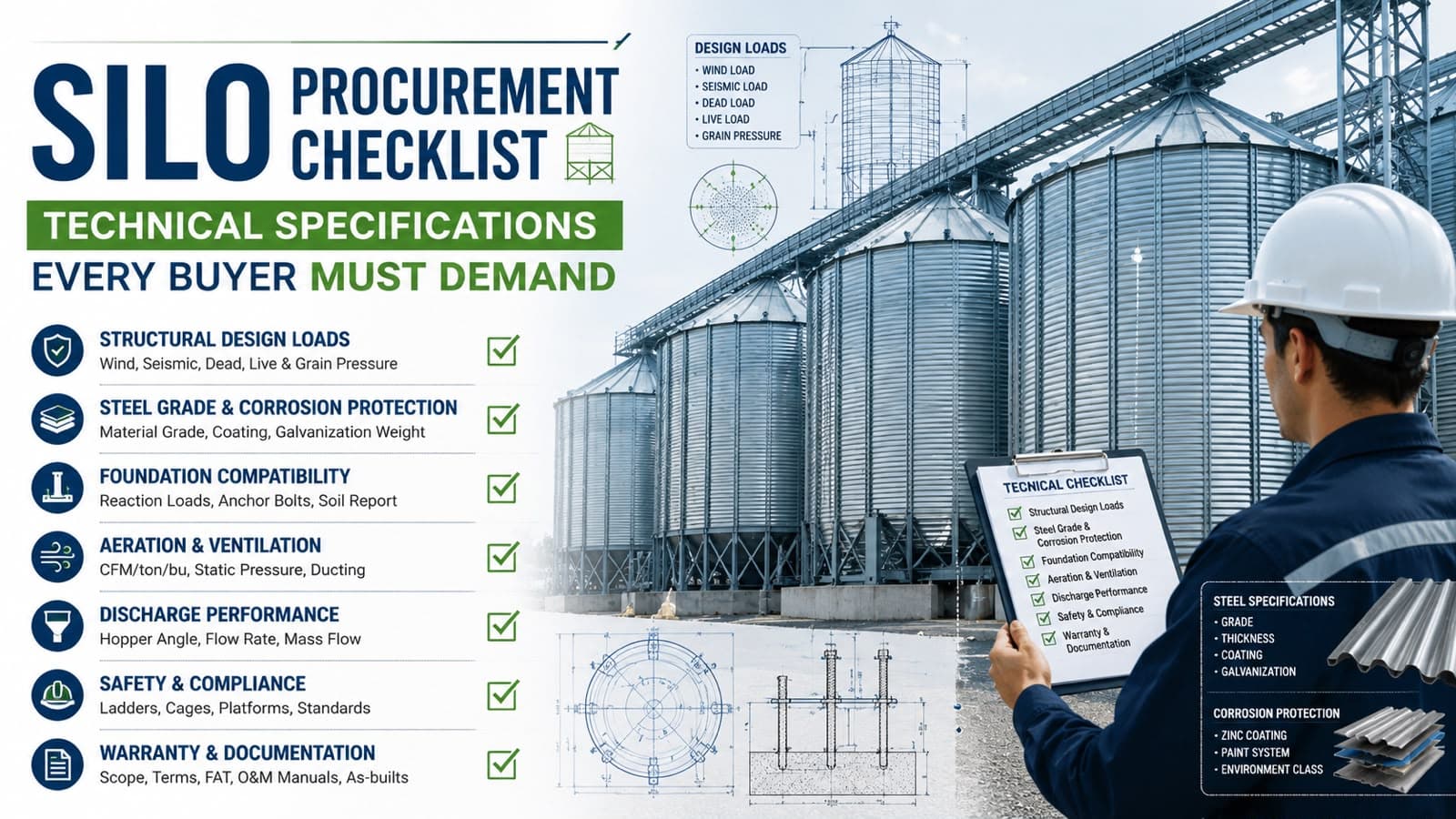
Grain Storage17 June 20269 min read
Silo Procurement Checklist: Technical Specifications Buyers Must Demand
T
Team Milling EquipsA technical silo procurement checklist covering structural design loads, steel grade, corrosion protection, aeration, and safety specifications every grain or biomass storage buyer must demand before signing a contract.
Buying a silo is a capital decision that locks in storage capacity, structural risk, and operating cost for 20-30 years. Yet a large share of procurement disputes in this industry trace back to the same root cause: the buyer's purchase order never specified the technical details that actually determine silo performance. A vague RFQ inviting quotes on "capacity and price" alone leaves enormous room for suppliers to under-specify steel gauge, skip critical safety features, or design to a lower load case than your operation actually needs. [Source: FAO — Grain Storage Techniques: Engineering Guidelines]
This checklist sets out the technical specifications every buyer — whether procuring a single farm bin or a multi-silo industrial complex — should demand in writing before signing a contract. At Milling Equips, we engineer and supply complete silo and storage solutions, and help buyers translate operational requirements into a specification a manufacturer cannot quietly water down.
1. Structural Design Loads and Governing Standard
The single most important line item in any silo specification is the design code the structure is engineered to. A silo designed only to a generic dead-load assumption, without explicit wind, seismic, and grain-pressure load combinations, can fail or deform under real-world conditions even if it looks identical to a properly engineered unit. [Source: ASABE EP433 — Loads Exerted by Free-Flowing Grain on Bins]
Demand written confirmation of:
- The specific design standard applied — e.g. EN 1991-4 (Eurocode), ASABE EP433/EP545, or IS 11598 — stated explicitly in the technical offer, not just "international standards"
- Wind load zone and basic wind speed used in the design calculation for your specific site location
- Seismic zone classification and the seismic load case applied, particularly relevant in Zone III, IV, and V regions of India
- Grain lateral and vertical pressure coefficients (Janssen or modified Janssen method) used to size wall thickness
- Snow load assumptions for the roof structure, if applicable to your region
Pro Tip from Milling Equips
Ask the supplier to provide the structural calculation summary sheet — not just the final drawing. A reputable manufacturer will share the governing load case, wall thickness derivation, and foundation reaction loads without hesitation. Reluctance to share this is a red flag.
2. Steel Grade, Sheet Thickness, and Corrosion Protection
Two silos can look visually identical while having a 30-40% difference in service life purely based on steel specification. This is the line item most frequently under-specified by low-cost suppliers, because thinner gauge and lighter coating are invisible to a buyer at the time of purchase.
- Steel grade and yield strength (e.g. S350GD+Z, equivalent to IS 513 or IS 277) stated explicitly per component — wall sheets, stiffeners, roof structure
- Sheet thickness (gauge) per ring/tier, since lower rings carrying greater grain pressure typically require thicker material than upper rings
- Galvanization coating weight — demand G300 or Z275/Z350 (grams of zinc per m²) rather than accepting an unspecified "galvanized" claim
- Bolt and fastener specification, including grade, corrosion coating, and torque specification — a frequent point of premature failure if under-specified
- Additional coating requirements for coastal, high-humidity, or chemically aggressive environments
3. Foundation Design and Soil Bearing Compatibility
A silo supplier who quotes only the silo structure — without coordinating foundation design against your actual site soil report — is transferring significant risk back onto you.
- Foundation reaction loads (total and per anchor point) provided in writing by the silo manufacturer's structural engineer
- Confirmation that foundation design has been cross-checked against your site-specific soil bearing capacity report, not a generic assumption
- Anchor bolt layout, embedment depth, and grout specification detailed in drawings — not left to the civil contractor's discretion
- Differential settlement tolerance the structure is designed to accommodate
4. Aeration, Ventilation, and Moisture Control Systems
Aeration is frequently sold as a vague line item ("aeration system included") without specifying the airflow rate that actually determines whether your grain stays in safe storage condition.
- Airflow rate specified in CFM per bushel or m³/hr per tonne — appropriate rates vary significantly by grain type and target storage duration
- Fan specification including static pressure rating matched to your silo height and grain depth, not a generic fan selection
- Duct layout drawings showing perforated floor or duct coverage percentage across the silo base
- Temperature cable specification — number of cables, sensor spacing, and monitoring system compatibility
- Roof ventilation capacity (ridge vents, powered exhaust) sized against your aeration fan's inlet airflow to avoid pressure imbalance
5. Discharge System and Flow Performance Guarantees
Discharge performance is one of the most commonly disputed items post-installation, because buyers rarely demand a written, measurable performance guarantee at the procurement stage.
- Hopper angle (degrees from horizontal) specified and justified against the angle of repose of your specific grain or biomass material
- Discharge rate guarantee in tonnes/hour or m³/hour, tested and documented at commissioning, not just a design estimate
- Bin activator or vibrating discharge equipment specification where cohesive or fine materials are involved
- Center well vs. full-floor discharge design clearly stated, with implications for cleanout completeness explained
- Gate and slide valve specification, including sealing performance to prevent leakage during storage
6. Safety, Access, and Regulatory Compliance Features
Safety features are the most common casualty of cost-cutting in low-bid silo proposals, since they add cost without adding visible storage capacity. [Source: OSHA — Grain Handling Safety Standards]
- External and internal ladder systems with safety cages, compliant with IS 4130 confined space access norms or equivalent local regulation
- Explosion relief panel sizing calculation provided for biomass or dusty grain applications, referencing NFPA 61 or equivalent
- Fall arrest anchor points at roof level and platform guardrail specifications
- Lockable access hatches and confined space entry signage included as standard, not as a chargeable extra
- Lightning protection and earthing system specification, particularly for tall steel silos in open locations
7. Warranty, Testing, and Documentation Requirements
The final category of specification is contractual rather than purely technical — but it determines whether you have any recourse if the silo underperforms.
- Warranty period and scope stated separately for structural steel, coating/galvanization, and mechanical components (aeration, discharge equipment)
- Factory acceptance testing (FAT) requirements for fabricated components before shipment, with the right to inspect or appoint a third party
- Mill test certificates for structural steel, confirming the grade and chemical composition matches the specification
- As-built drawings and structural calculation package handed over at project completion, not just installation manuals
- Spare parts list and lead times for wear components — bearings, fan motors, gate seals — documented at the time of purchase
Procurement Note
Insist that every item in this checklist appears in the commercial contract or technical annexure — not just in pre-sale conversation. Verbal assurances about steel grade or load design have no value in a dispute. If a supplier resists putting specifications in writing, treat it as a signal to look elsewhere.
Silo Procurement Checklist Summary
| Category | Must Demand In Writing | Why It Matters |
|---|---|---|
| Structural Design | Governing code, wind/seismic load, grain pressure case | Prevents under-engineered structure |
| Steel & Corrosion | Grade, gauge per ring, galvanization weight | Determines 20–30 yr service life |
| Foundation | Reaction loads matched to soil report | Prevents settlement & structural risk |
| Aeration | CFM/bushel, fan static pressure, duct coverage | Prevents grain spoilage in storage |
| Discharge | Hopper angle, guaranteed flow rate (t/hr) | Avoids post-installation disputes |
| Safety & Compliance | Ladder/cage, explosion relief, fall arrest | Regulatory compliance & worker safety |
| Warranty & Docs | Warranty scope, FAT, mill certs, as-builts | Your only recourse if it underperforms |
Conclusion
A silo purchase order that specifies only capacity, material (steel/concrete), and price is not a procurement specification — it is an invitation for the lowest-cost supplier to win on price while quietly cutting corners on the items that determine long-term performance. The seven categories in this checklist are the minimum technical detail that should appear in any RFQ, technical offer, and final contract.
Buyers who insist on this level of specification consistently report fewer disputes, longer service life, and significantly lower total cost of ownership — even when the upfront quoted price is higher than a vague, low-cost alternative.
Need help drafting a technical specification for your next silo project, or reviewing a supplier's proposal before you sign? Contact Milling Equips today for an independent technical review.
Frequently Asked Questions (FAQ)
What load cases must a silo design account for?
A properly engineered silo design must account for grain dead load (lateral and vertical pressure using Janssen's method), wind load specific to the site's basic wind speed, seismic load appropriate to the site's seismic zone, and roof snow load where applicable. The combination of these load cases, not any single one, determines the required wall thickness and foundation design.
Why does galvanization coating weight matter for silo steel?
Galvanization coating weight, measured in grams of zinc per square metre (e.g. Z275, Z350), directly determines corrosion resistance and therefore structural service life. A silo specified with a lighter coating weight may look identical at handover but can show significant corrosion and reduced load capacity within 8–10 years, compared to 25-30+ years for a properly coated structure.
Who is responsible for foundation design — the silo manufacturer or the civil contractor?
Foundation design responsibility should be explicitly assigned in the contract. Best practice is for the silo manufacturer's structural engineer to provide foundation reaction loads in writing, which the civil contractor then uses — cross-checked against an independent soil bearing capacity report for the specific site. Buyers should never accept a generic foundation design that wasn't validated against their actual soil conditions.
What aeration airflow rate is considered adequate for grain storage?
Adequate aeration airflow rates vary by grain type, moisture content, and intended storage duration, but are typically specified in the range of 0.1 to 0.2 CFM per bushel for short-term storage and higher rates for long-term or high-moisture storage. The exact rate should be calculated for your specific grain and climate conditions, not assumed from a generic 'aeration included' line item.
What should be included in a silo factory acceptance test?
A factory acceptance test (FAT) should verify dimensional accuracy of fabricated panels, coating thickness and adhesion, weld quality on structural components, and mechanical equipment function (fans, gates, discharge mechanisms) before shipment. Buyers or their appointed third-party inspector should have contractual rights to attend or review FAT documentation before goods are dispatched.
Ready to upgrade your milling setup?
Discuss your plant requirements with our engineering team today.