Back to all articles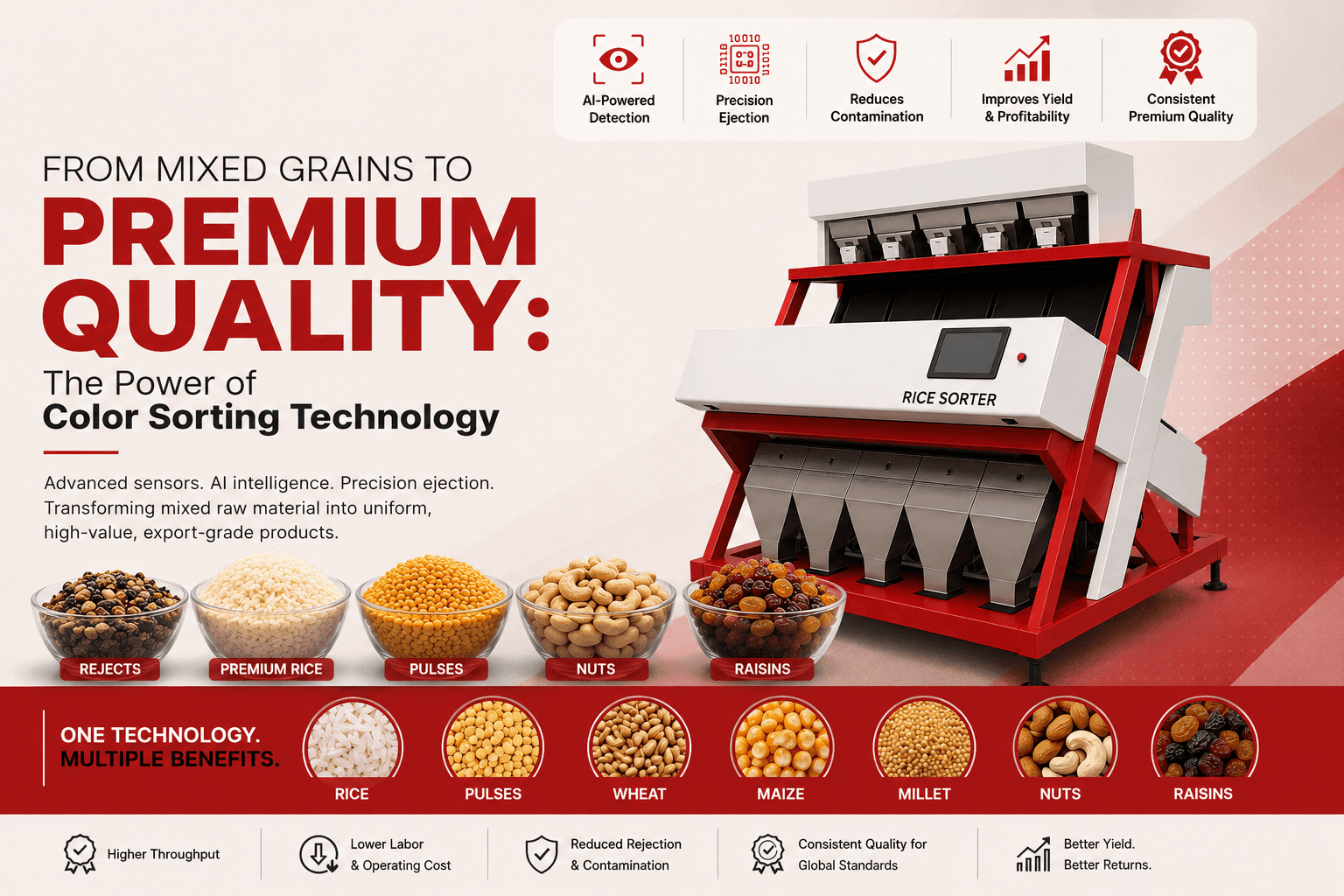
Grain and Food Processing5 July 20269 min read
From Mixed Grains to Premium Quality: The Power of Color Sorting Technology
T
Team Milling EquipsDiscover how color sorting technology turns mixed rice, pulses, grains, nuts, and raisins into premium-quality products — cutting waste, labor, and rejection rates.
Every batch of rice, pulses, grains, nuts, or raisins arrives at a processing plant as a mix of the good, the flawed, and the outright unwanted — discolored kernels, insect-damaged seeds, stones, husk, and foreign matter travel alongside the premium product all the way from field to factory. Color sorting technology is the step that separates the two, converting an inconsistent raw stream into a uniform, export-grade finished product.
At Milling Equips, we work with rice millers, pulse processors, and specialty food exporters across India and internationally to specify and integrate advanced color sorting solutions that meet both domestic quality expectations and international buyer standards.
1. How Color Sorting Technology Actually Works
A modern color sorter feeds product through a vibrating chute or conveyor belt past a bank of high-resolution CCD or CMOS cameras, often paired with near-infrared (NIR) or hyperspectral sensors. Each sensor captures the color, shape, and surface characteristics of every individual grain or particle in real time, comparing it against a pre-set quality profile. [Source: Wikipedia — Colour Sorter]
When a defective, discolored, or foreign particle is detected, a bank of high-speed pneumatic ejectors fires a precise burst of compressed air — lasting only milliseconds — to knock that single particle out of the product stream without disturbing the surrounding good product.
Core components of a color sorting system:
- ✔ High-resolution optical sensors (RGB, CCD, or CMOS) for color and shape detection
- ✔ NIR / hyperspectral sensors for detecting defects invisible to the human eye, such as internal mold or moisture damage
- ✔ AI-powered image processing algorithms that continuously refine defect-recognition accuracy
- ✔ Precision pneumatic ejection valves capable of thousands of activations per minute
- ✔ Recirculation chutes that reprocess borderline material for a second pass, minimizing loss of good product
Pro Tip from Milling Equips
The single biggest driver of sorting accuracy isn't the camera resolution — it's correct machine calibration for your specific product. A rice color sorter calibrated for long-grain basmati will under-perform on broken parboiled rice unless the ejector timing and color thresholds are re-tuned for the new profile.
2. Rice Milling: The Original and Largest Application
Rice sorting was the technology's first major commercial market, and remains its largest. Color sorters are typically installed as the final step after polishing, where they separate chalky, yellow, and discolored kernels, unhulled paddy, and small stones from the finished white or brown rice. [Source: Wikipedia — Rice Color Sorting Machine]
- ✔ Removal of discolored, chalky, and immature kernels that affect visual grade
- ✔ Separation of unmilled or partially milled paddy grains
- ✔ Elimination of stones, glass, and other dense foreign material that pose a safety hazard
- ✔ Multi-pass sorting for premium export-grade basmati and specialty rice varieties
See our full range of rice milling solutions for how color sorting fits into a complete processing line.
3. Pulses and Lentils: Removing Discoloration, Damage, and Foreign Seeds
Pulse processing presents a different challenge: lentils, chickpeas, and beans are prone to insect damage, mold spotting, and cross-contamination with other seed varieties during harvest and transport.
- ✔ Removal of discolored, spotted, or insect-damaged dal and lentils
- ✔ Separation of foreign seeds and weed seeds that resemble the target pulse in size but differ in color
- ✔ Consistent grading for branded, packaged pulse products where visual uniformity drives consumer purchase decisions
- ✔ Reduced dependency on manual picking tables, which are slow, inconsistent, and labor-intensive
4. Nuts and Raisins: Meeting Premium Export Standards
For high-value commodities like cashews, almonds, peanuts, and raisins, visual defects have an outsized effect on price realization. A single batch contaminated with shell fragments, immature nuts, or over-dried raisins can be rejected entirely by an export buyer.
- ✔ Detection of shell fragments and skin defects in cashews, almonds, and peanuts
- ✔ Separation of under-ripe, over-dried, or moldy raisins from the premium grade
- ✔ Sorting to buyer-specific color and size specifications for private-label export contracts
- ✔ Non-destructive handling suited to delicate, high-value products where breakage reduces value
5. Specialty Grains: Wheat, Maize, and Millets
Wheat, maize, and millets each carry their own set of visual defect challenges. Wheat lots frequently contain shrunken or sprouted grains, ergot-affected kernels, and weed seeds that must be separated to meet flour-milling and export-grade specifications. Maize is prone to aflatoxin-linked discoloration, insect damage, and broken kernels that affect both food-grade and feed-grade pricing. Millets — including jowar, bajra, ragi, and the smaller minor millets now in high export demand — are small-grained and highly variable in color, making manual sorting especially slow and inconsistent.
- ✔ Removal of shrunken, sprouted, or ergot-affected wheat kernels ahead of milling
- ✔ Separation of discolored and insect-damaged maize kernels linked to aflatoxin risk
- ✔ Fine-tuned sorting profiles for small-grained millets (jowar, bajra, ragi, and minor millets) where manual picking is impractical at scale
- ✔ Removal of weed seeds, chaff, and foreign grain varieties that affect flour color and purity
- ✔ Support for the growing millet export and 'Shree Anna' processing segment, where buyers increasingly specify visual purity standards
6. Hyperspectral and AI-Powered Imaging: The Next Leap in Detection Accuracy
Standard RGB color sorters can only detect what is visible to a camera operating in the visible light spectrum. Hyperspectral and multispectral imaging systems capture data across dozens or hundreds of wavelength bands, revealing defects invisible to the human eye and to conventional cameras — including internal insect infestation, early-stage mold, and chemical residues. [Source: Specim — Hyperspectral Imaging in Food Quality and Safety]
- ✔ Detection of internal defects and contamination not visible on the grain surface
- ✔ Machine-learning classifiers that improve defect recognition accuracy with every production run
- ✔ Non-destructive, real-time inline inspection suited to continuous high-throughput lines
- ✔ Growing research base validating hyperspectral imaging for foreign-matter and adulteration detection in food [Source: Li et al., Foods journal, 2025]
7. The Operational and Financial Case: Reducing Waste, Labor, and Rejection Rates
Post-harvest losses remain a major drain on the global food system — FAO estimates that roughly 8.4% of cereals and pulses are lost between harvest and retail, much of it from quality defects that could be sorted out and salvaged rather than discarded. [Source: FAO — SDG Indicator 12.3.1, Global Food Losses] [Source: FAO — Policy Series: Food Loss & Food Waste]
- ✔ Manual sorting tables require large labor teams, are inconsistent between shifts, and struggle to scale with production volume
- ✔ Automated color sorting typically processes far higher volumes per hour than manual picking, at a consistent quality standard
- ✔ Recirculation and reprocessing features recover marginal product instead of discarding it outright, improving overall yield
- ✔ Lower rejection rates at the buyer or export inspection stage reduce costly return shipments and contract disputes
Efficiency Benchmark
Processors switching from manual picking tables to automated color sorting commonly report double-digit reductions in labor headcount for the sorting stage, alongside a measurable drop in customer complaints tied to visual defects. A Milling Equips process audit can benchmark your current rejection rate against what automated sorting could achieve.
8. Food Safety, Certification, and Export Compliance
Beyond appearance, color sorting plays a direct role in food safety by removing foreign material — stones, glass, metal fragments, and insect matter — before it reaches packaging. This is increasingly a documented requirement under HACCP-based food safety systems and a precondition for export contracts.
- ✔ Foreign-material removal supports compliance with HACCP and other food safety management systems
- ✔ Batch-level sorting logs provide traceability documentation increasingly requested by export buyers and auditors
- ✔ Consistent, defect-free product supports compliance with destination-market grading and labeling standards
- ✔ Reduced reliance on manual inspection lowers the risk of human error in safety-critical foreign-material detection
Food Safety Note
Foreign-material contamination is one of the most common triggers for export consignment rejection. Positioning a color sorter as a dedicated food-safety checkpoint — not just a cosmetic quality step — is increasingly standard practice among processors seeking ISO and HACCP-aligned certification.
Application Summary: Color Sorting Across Food Categories
| Application | Key Benefit | Impact |
|---|---|---|
| Rice | Removes chalky/discolored kernels, paddy, stones | Higher export grade, food safety |
| Pulses & Lentils | Removes spotted, damaged, foreign seeds | Reduced manual picking labor |
| Nuts | Detects shell fragments, skin defects | Premium price realization |
| Raisins & Dried Fruit | Separates under/over-dried, moldy product | Consistent export-grade batches |
| Specialty Grains (Wheat, Maize, Millets) | Removes shrunken/sprouted wheat, discolored maize, impurities in millets | Milling-grade purity, export compliance |
| All Categories | Hyperspectral detection of hidden defects | Reduced contamination risk |
| All Categories | Automated ejection vs. manual picking | Higher throughput, lower cost/tonne |
Conclusion
Color sorting technology has moved from a nice-to-have quality step to a commercial necessity for processors competing on both price and quality. Whether the raw material is rice, pulses, nuts, or raisins, the ability to consistently convert mixed, imperfect input into a uniform premium product directly affects yield, labor cost, and market access.
As buyers and regulators continue raising the bar on visual quality and food safety documentation, processors who invest in modern, AI-enabled color sorting will hold a durable edge over those still relying on manual inspection.
Ready to evaluate color sorting technology for your rice, pulse, or specialty food processing line? Contact Milling Equips today for a technical consultation on machine selection, integration, and throughput planning.
Frequently Asked Questions (FAQ)
What is color sorting technology and how does it work?
Color sorting technology uses high-resolution optical sensors — sometimes combined with near-infrared or hyperspectral sensors — to scan individual grains, seeds, or particles as they move through a chute or belt. An AI-driven image processing system identifies defective, discolored, or foreign material, and precision pneumatic ejectors remove it from the product stream in real time.
Which food products can be processed with color sorting machines?
Color sorters are used across rice, wheat, pulses and lentils, nuts such as cashews, almonds, and peanuts, dried fruits including raisins, as well as coffee, tea, and specialty seeds. Machines are typically calibrated to the specific color, size, and shape profile of each product.
How much can color sorting reduce waste and manual labor in a processing plant?
The exact figure depends on the current process, but processors moving from manual picking tables to automated color sorting typically see a substantial reduction in sorting-stage labor headcount along with more consistent rejection rates and fewer buyer complaints tied to visual defects.
What is the difference between standard optical color sorters and hyperspectral sorters?
Standard optical (RGB/CCD) sorters detect defects visible in ordinary light, such as discoloration and obvious foreign material. Hyperspectral and multispectral sorters capture data across many additional wavelength bands, enabling detection of internal defects, early mold, and contamination that are invisible to a standard camera.
How can Milling Equips help with color sorting technology upgrades?
Milling Equips supports food processors end-to-end — from feedstock and defect-profile analysis through machine selection, installation, commissioning, and operator training. We also provide OEM-compatible spare parts and ongoing maintenance support.
Ready to upgrade your milling setup?
Discuss your plant requirements with our engineering team today.