Back to all articles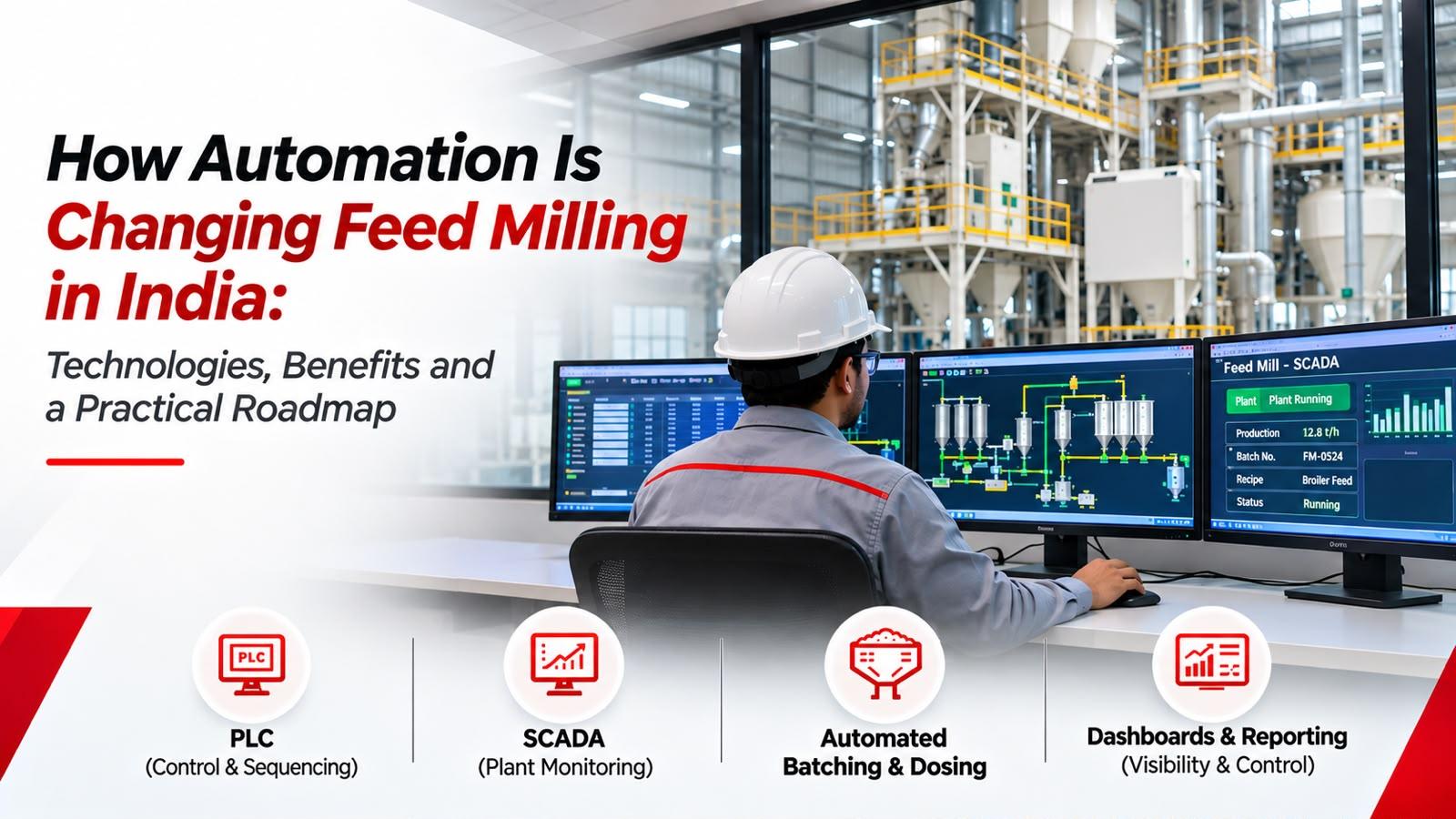
Feed Milling11 November 202610 min read
How Automation Is Changing Feed Milling in India: Technologies, Benefits and a Practical Roadmap
T
Team Milling EquipsSee how automation is changing feed milling in India. Learn how PLC, SCADA, automated batching and real-time dashboards cut errors, waste and labour dependency.
Walk into a feed mill ten years ago and you would find operators standing at manual control panels, writing batch figures in registers, and relying on experience to judge when a machine was struggling. Walk into a modern feed mill today and you are just as likely to find a control room, a live dashboard, and a system that records every batch automatically. Automation is quietly becoming the biggest competitive divider in Indian feed manufacturing.
The pressure behind this shift is practical, not fashionable. Raw material prices move constantly, customers expect consistent nutrition in every bag, labour is harder to find and retain, and margins leave little room for waste. Automation helps feed mills answer all four problems at once. It reduces formulation errors, cuts waste, lowers dependency on individual operators, and gives managers the data they need to make decisions based on facts rather than guesswork.
This guide explains the technologies behind feed mill automation, where each one delivers the most value, what challenges to expect, and how to build a realistic roadmap for your plant. At Milling Equips, we support feed manufacturers with digital services and automation solutions alongside complete feed milling solutions designed for modern, data-driven operations.
1. Why Automation Matters Now for Indian Feed Mills
India's livestock, poultry, and aquaculture sectors continue to professionalise, and feed buyers are becoming more quality-conscious. Integrators and large farms now audit their feed suppliers, ask for batch records, and compare nutrient consistency between deliveries. A feed mill that cannot show documented, repeatable production is increasingly at a disadvantage when bidding for larger accounts.
| Business Pressure | How Automation Responds |
|---|---|
| Customers demand consistent nutrition in every bag | Automated batching follows the formula exactly, every time, and records the actual weights used |
| Raw material costs are volatile and over-dosing wastes money | Precise weighing and dosing removes over-formulation and protects margins |
| Skilled operators are hard to find and retain | Automated sequences reduce dependence on individual experience and make training easier |
| Buyers and regulators expect traceability | Systems log batch data, ingredient lots, and process parameters automatically |
| Energy and maintenance costs keep rising | Process control and monitoring reduce energy waste and catch equipment problems early |
| Owners want visibility without being on the plant floor | Dashboards and remote monitoring show production status from anywhere |
2. The Core Technologies Behind Feed Mill Automation
Automation is not a single product. It is a stack of technologies that work together. Understanding what each layer does helps you decide where to start and what to buy.
| Technology | What It Does in a Feed Mill |
|---|---|
| PLC (Programmable Logic Controller) | The brain of the plant. Runs interlocks and sequences so machines start, stop, and respond in the correct order without manual intervention. |
| SCADA (Supervisory Control and Data Acquisition) | The visual control layer. Shows the entire plant on a screen, lets operators control equipment, and stores historical production data. |
| Automated batching and dosing | Weighs and releases macro and micro ingredients according to the formula, with tolerance checks and automatic correction. |
| Variable Frequency Drives (VFDs) | Adjust motor speed to match the load, which saves energy and allows smoother feed rate control on mills, fans, and conveyors. |
| Sensors and IoT devices | Measure temperature, moisture, motor load, vibration, and level, and send readings to the control system in real time. |
| Dashboards and reporting | Convert raw data into production, downtime, energy, and quality reports that managers can act on. |
The International Society of Automation publishes widely used standards and guidance on industrial automation and control systems. You can explore their resources at the International Society of Automation (ISA), which is a useful reference when specifying control systems for any manufacturing plant.
3. Where Automation Delivers the Biggest Impact, Stage by Stage
You do not need to automate everything on day one. The most successful projects begin where the financial and quality impact is greatest. This table shows what automation can do at each stage of the process:
| Process Stage | What Automation Improves |
|---|---|
| Raw material intake and storage | Level monitoring in silos, automatic bin selection, and reduced risk of mixing up ingredients |
| Grinding | Load-based feed rate control keeps the hammer mill at its best operating point and protects screens and motors, which helps avoid the hidden costs of poor grinding. |
| Batching and mixing | Accurate weighing, correct ingredient sequence, controlled mixing time, and automatic batch records |
| Conditioning and pelleting | Steam, temperature, and motor load control produce more consistent PDI and fewer die blockages |
| Drying and cooling | Moisture and temperature feedback adjust residence time and airflow, preventing over-drying and under-cooling |
| Oil coating | Flow-metered dosing keeps fat inclusion within tolerance from batch to batch |
| Bagging and dispatch | Automatic weighing, bag counting, and lot labelling support traceability |
These stages are closely linked. For example, better conditioning control reduces the load on your dryer, and accurate batching improves mixing quality. To understand how each process affects the next, read our related blogs on pelleting quality and common problems and the true cost of poor cooling.
4. The Business Benefits You Can Expect
The value of automation shows up across quality, cost, and management. Results vary by plant and starting point, but these are the benefits feed mills most commonly report:
- ✔ Formulation accuracy: automated weighing removes manual dosing errors, so every batch matches the formula and customers receive consistent nutrition.
- ✔ Less waste and over-dosing: tight tolerances on expensive ingredients and premixes reduce giveaway, which protects margin on every tonne.
- ✔ Traceability and audit readiness: batch records, ingredient lots, and process data are stored automatically, which supports customer audits and food safety requirements.
- ✔ Lower energy use: VFDs and load-based control avoid running motors harder than necessary and reduce idle running.
- ✔ Fewer breakdowns: monitoring of vibration, temperature, and motor load flags problems early, supporting a stronger preventive maintenance programme.
- ✔ Reduced labour dependency: standardised sequences mean output depends less on one experienced operator and new staff become productive faster.
- ✔ Better decisions: managers see downtime reasons, energy per tonne, and throughput trends, and can act on facts instead of impressions.
Food and feed safety bodies also stress documented process control. The Food and Agriculture Organization of the United Nations (FAO) publishes good practices for safe animal feed manufacturing, and automated record keeping makes it much easier to demonstrate that those practices are followed.
5. Levels of Automation: Choosing the Right Starting Point
Automation is not all or nothing. Most Indian feed mills move through levels as their budget, volumes, and customer requirements grow. Use this comparison to decide where your plant sits today and where it should go next.
| Level | What It Looks Like | Best Suited For |
|---|---|---|
| Manual | Operators control machines individually and record data on paper | Very small plants with low volumes and simple formulas |
| Semi-automatic | PLC interlocks and automated batching, with manual starts and local panels | Growing plants that want accuracy without a large investment |
| Fully automatic with SCADA | Centralised control, recipe management, automatic sequences, and full reporting | Medium and large plants, multiple product lines, and audited suppliers |
| Connected and data-driven | SCADA plus remote monitoring, condition monitoring, and management dashboards | Multi-site operators and plants targeting maximum efficiency |
6. Common Challenges and How to Overcome Them
Automation projects succeed when the challenges are understood in advance. These are the issues Indian feed mills most often face and the practical ways to handle them:
| Challenge | Practical Solution |
|---|---|
| Upfront investment feels high | Phase the project. Start with batching and the highest-impact stages, then expand as savings are proven. |
| Older machines with no digital interface | Retrofit sensors, drives, and PLC panels. Many legacy machines can be integrated without full replacement. |
| Operators worry about change | Involve them early and provide structured hands-on training before and after go-live so the team trusts the system. |
| Unstable power supply and dust | Use proper panel enclosures, surge protection, and stabilised power for control equipment. |
| Data collected but not used | Define a small set of KPIs first, such as downtime, energy per tonne, and batch accuracy, and review them weekly. |
| Dependence on a single vendor for support | Choose partners who provide local service, spare parts, and documentation, and keep critical spares in stock. |
Training is the factor most often underestimated. Even the best system fails if the team does not trust or understand it. Explore our training and courses to prepare your operators and supervisors before and after any automation upgrade.
7. A Practical Roadmap to Automate Your Feed Mill
If you are considering automation, follow a structured path rather than buying equipment first. This approach reduces risk and keeps spending tied to results:
Step 1: Audit Your Current Plant
List every machine, how it is controlled today, and where errors, waste, and downtime occur most often. Record baseline figures for energy per tonne, batch accuracy, downtime hours, and rejected batches so you can measure improvement later.
Step 2: Prioritise by Impact
Rank opportunities by financial and quality impact. For most plants the order is batching and dosing first, then pellet mill and conditioning control, then drying, cooling, and coating control, then reporting and remote monitoring.
Step 3: Specify the System Clearly
Define the number of ingredients, bins, batch sizes, recipes, and reports you need. Ask for open, well-documented systems so you are not locked into one supplier. Confirm local service support and availability of spare parts.
Step 4: Install, Train and Run in Parallel
Commission in phases and run manual and automatic modes side by side at first. Train operators and maintenance staff on daily use, alarms, and basic troubleshooting.
Step 5: Measure, Review and Expand
Compare results to your baseline after 60 to 90 days. Use the savings and quality gains to justify the next phase, such as remote monitoring or condition-based maintenance.
Conclusion
Automation is changing feed milling in India because it solves problems every plant already has: inconsistent batches, wasted ingredients, rising energy costs, unplanned downtime, and shortage of skilled labour. It does not replace good operators or sound process knowledge. It gives them better tools, better data, and fewer opportunities to make costly errors.
The best way forward is a phased, practical approach. Start where the impact is greatest, measure the results, train your people, and build from there. Plants that do this are better placed to win larger customers, meet audit requirements, and protect their margins as the industry grows.
Ready to explore automation for your feed mill? Contact Milling Equips for a free assessment of your plant. Learn more about our digital services, feed milling solutions, and spare parts support to keep your automated plant running smoothly.
Frequently Asked Questions (FAQ)
What is the difference between PLC and SCADA in a feed mill?
A PLC is the controller that runs the plant logic, such as starting machines in sequence and applying safety interlocks. SCADA is the supervisory software that displays the plant on a screen, lets operators issue commands, and stores production data and reports. Most modern feed mills use both together.
Can an older feed mill be automated without replacing all machinery?
Yes, in many cases. Existing machines can often be integrated by adding sensors, variable frequency drives, and PLC panels. A site assessment will show which machines can be retrofitted and which may need upgrades for safe, reliable automation.
Which part of the plant should be automated first?
Most plants start with batching and dosing because it directly affects formulation accuracy, ingredient cost, and product consistency. The next priorities are usually pellet mill and conditioning control, followed by drying, cooling, coating, and reporting.
Does automation reduce the need for skilled operators?
Automation reduces dependence on manual judgement for routine tasks, but it does not remove the need for skilled people. Operators and supervisors still need to understand the process, respond to alarms, and review data. Good training is essential to get full value from any system.
Does Milling Equips offer automation and digital services for feed mills?
Yes. Milling Equips provides automation and digital services for feed mills, including PLC and SCADA based control, automated batching, and remote monitoring, along with complete feed milling solutions, maintenance support, spare parts, and operator training. Contact our team to discuss the right automation approach for your plant.
Ready to upgrade your milling setup?
Discuss your plant requirements with our engineering team today.