Back to all articles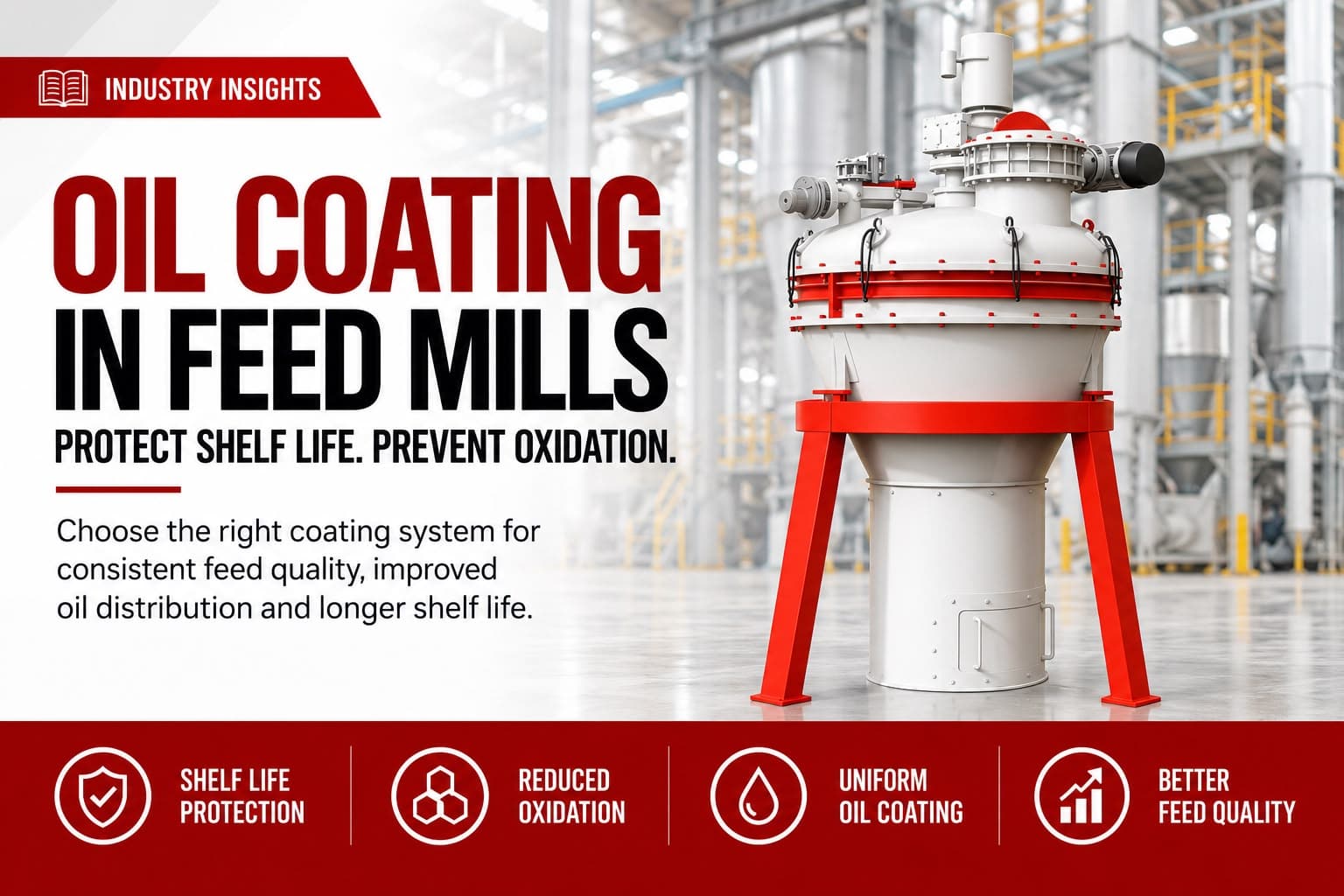
Industry Insights26 October 202611 min read
Oil Coating in Feed Mills: How It Protects Shelf Life, Prevents Oxidation and Which System to Choose
T
Team Milling EquipsLearn how oil coating extends feed shelf life and prevents oxidation, and how to choose between a drum coater and a vacuum coater for your feed mill.
Oil coating is one of the most commercially valuable steps in modern feed manufacturing, yet it remains one of the least understood. Most feed mill operators think of post-pellet oil coating primarily as a way to add energy density or improve palatability. These are real benefits. But the shelf life and oxidation protection that correctly applied oil coating delivers are equally significant and far less discussed.
In the Indian feed industry, where ambient temperatures regularly exceed 35 to 40 degrees Celsius and supply chains can expose bagged feed to weeks of transit and storage, rancidity and oxidation are silent but costly threats that shorten safe shelf life, reduce feed palatability, and undermine animal performance. Oil coating, when applied correctly with the right system, is one of the most effective tools available to combat these threats.
This blog covers two dimensions every feed mill operator needs to understand: why oil coating protects feed shelf life and prevents oxidation, and how to choose between a drum coater and a vacuum coater for your specific production needs. At Milling Equips, we supply and support complete feed milling solutions including oil coating systems for all feed types and production scales.
1. What Oil Coating Actually Does to Your Feed Pellet
Post-pellet oil coating is the process of applying a controlled quantity of fat, oil, or liquid additive to the surface of cooled pellets after they leave the pellet mill and cooler. The coating is applied by spraying oil onto tumbling or fluidised pellets, where it is absorbed into the outer surface layer of the pellet structure.
Understanding what happens at a physical and chemical level during coating helps explain why it is so effective as a shelf life and oxidation protection tool:
| Oil Coating Function | Effect on Feed Quality and Shelf Life |
|---|---|
| Moisture barrier formation | Oil is hydrophobic: a correctly applied coating reduces the rate at which pellets absorb ambient moisture during storage and transport, directly extending safe shelf life |
| Oxygen exclusion at pellet surface | The oil layer reduces the surface area of feed exposed directly to atmospheric oxygen, slowing the oxidation of fats, vitamins, and unsaturated fatty acids within the pellet |
| Rancidity prevention | By limiting oxygen contact with the fat-containing ingredients inside the pellet, oil coating significantly slows the development of rancid flavours and odours that reduce palatability and FCR |
| Antioxidant delivery vehicle | Liquid antioxidants such as ethoxyquin, BHA, and mixed tocopherols are most effectively applied as part of the coating oil, distributing them evenly across the entire pellet surface |
| Energy density increase | Each 1% of added post-pellet fat adds approximately 36 to 40 kcal of metabolisable energy per kg of feed, increasing energy density without increasing feed intake volume |
| Palatability improvement | Oil coating improves the sensory characteristics of feed, including texture, aroma, and mouthfeel, which improves voluntary intake especially in aqua feed and pet food applications |
Why Post-Pellet Coating Is Preferred Over Pre-Pellet Addition
Fat added before pelleting lubricates the pellet mill die, reducing compression and lowering PDI. High pre-pellet fat inclusion (above 3 to 4%) also inhibits starch gelatinisation during conditioning, producing weaker, less durable pellets. Post-pellet coating avoids all these problems. It allows fat inclusion levels of 3 to 8% or higher to be achieved without any negative impact on pellet quality, while delivering superior coating uniformity and antioxidant distribution.
2. How Oil Coating Prevents Rancidity and Oxidation in Finished Feed
Rancidity is the chemical deterioration of fats and oils through oxidation, producing off-flavours, unpleasant odours, and reduced nutritional value. In finished feed, rancidity develops when unsaturated fatty acids in raw ingredients and added fats react with atmospheric oxygen, a process that is accelerated by heat, light, and moisture. In Indian conditions, all three are present in abundance during summer months and in warm warehouses and transport vehicles.
- ✔ Primary oxidation: oxygen reacts with polyunsaturated fatty acids in fishmeal, soya oil, and added fats to form hydroperoxides. This stage is largely odourless but destroys essential fatty acids and reduces energy availability to the animal
- ✔ Secondary oxidation: hydroperoxides break down into aldehydes, ketones, and short-chain fatty acids that produce the characteristic rancid smell and taste that causes animals to reduce or refuse feed intake
- ✔ Vitamin destruction: oxidation destroys fat-soluble vitamins A, D, E, and K within the pellet, reducing the nutritional value of the feed even before any visible sign of rancidity appears
- ✔ Tocopherol depletion: natural vitamin E in raw ingredients acts as the primary antioxidant defence. Once it is depleted by oxidative stress, the rate of rancidity development accelerates rapidly
Correctly applied oil coating addresses each of these mechanisms simultaneously: the oil layer reduces oxygen access to the pellet surface, delivers antioxidants directly to where they are most effective, and reduces moisture ingress that catalyses oxidative reactions. According to the American Oil Chemists Society (AOCS), the combination of oxygen barrier coating and surface-applied antioxidants is the most effective strategy for extending oxidative shelf life in lipid-containing food and feed products.
| Oxidation Risk | Feed Type and Storage Condition |
|---|---|
| High risk | Fish meal-based aqua feed stored in warm warehouses above 30 degrees |
| High risk | High-fat poultry starter feed in summer months in coastal regions |
| Medium risk | Standard compound feed stored for more than 6 weeks |
| Lower risk | Ruminant feed with lower unsaturated fat content stored in cool, dry conditions |
Antioxidant inclusion in coating oil is strongly recommended for all high-risk categories. Consult your nutritionist for species-specific antioxidant type and inclusion levels.
3. Drum Coater vs. Vacuum Coater: Understanding the Difference
The two principal oil coating technologies used in feed mills are the drum coater and the vacuum coater. Each works on a fundamentally different principle, achieves different coating uniformity and fat inclusion levels, and is suited to different feed types and production requirements. Choosing the right system is a decision that will affect your coating quality and operating costs for the lifetime of the equipment.
Drum Coater: How It Works
Pellets are fed into a rotating horizontal drum. As the drum rotates, pellets tumble continuously while oil is sprayed onto them through nozzles positioned inside the drum. The tumbling action distributes the oil across the pellet surface through repeated contact and rolling between pellets.
- ✔ Fat inclusion level achievable: 1 to 4% post-pellet
- ✔ Coating uniformity: good for standard fat levels. Uniformity declines above 3 to 4% as excess oil pools rather than being absorbed
- ✔ Best application: standard compound feed, poultry feed, cattle feed, and lower-fat formulas
- ✔ Capital cost: lower than a vacuum coater
- ✔ Cleaning: relatively straightforward with hot water and detergent flushing
- ✔ Residence time: typically 2 to 5 minutes depending on drum length and rotation speed
Vacuum Coater: How It Works
Pellets are loaded into a pressure vessel. The vessel is first evacuated to create a vacuum inside the pellet structure, opening the porous internal channels. Oil is then admitted under pressure, forcing it deep into the pellet interior rather than remaining only on the surface.
- ✔ Fat inclusion level achievable: 3 to 12% and above
- ✔ Coating uniformity: excellent even at high fat levels, because oil penetrates the pellet interior
- ✔ Best application: aqua feed, pet food, and specialty feeds
- ✔ Capital cost: higher than a drum coater
- ✔ Cleaning: more complex due to the pressure vessel and valve systems
- ✔ Cycle time: a batch process, typically 5 to 15 minutes per batch including vacuum and pressure cycles
4. Drum Coater vs. Vacuum Coater: Full Comparison
Use this comparison to evaluate which system best fits your feed type, production volume, and fat inclusion requirements:
| Criteria | Drum Coater | Vacuum Coater |
|---|---|---|
| Working principle | Surface spray onto tumbling pellets | Vacuum evacuation then pressurised oil infusion |
| Fat inclusion level | 1 to 4% reliably | 3 to 12%+ possible |
| Coating location | Pellet surface only | Surface and internal pellet structure |
| Coating uniformity | Good at low fat levels | Excellent at all fat levels |
| PDI impact | Minimal at 1 to 3% fat | Minimal: coating post-pellet has no die impact |
| Best feed type | Compound feed, poultry, cattle | Aqua feed, pet food, high-energy specialty feeds |
| Production mode | Continuous | Batch |
| Capital cost | Low to medium | Medium to high |
| Maintenance complexity | Low | Medium: pressure systems require regular inspection |
| Cleaning requirement | Daily: flushing with hot oil or solvent | After each batch: vessel and valve cleaning |
| Antioxidant delivery | Surface application only | Deep internal delivery for maximum protection |
| Shelf life benefit | Good: reduces surface oxidation and moisture | Excellent: internal coating provides superior protection |
Not sure which system is right for your plant? Contact the Milling Equips technical team for a free consultation based on your feed type, fat inclusion target, production capacity, and budget.
5. Choosing the Right Coating Oil and Antioxidant
The quality of your oil coating outcome depends not just on the equipment you use but on the oil and additive specification you apply. These are the key decisions:
- ✔ Oil type selection: soya oil, palm oil, sunflower oil, and fish oil are most commonly used. For aqua feed, fish oil improves palatability and delivers omega-3 fatty acids. For poultry feed, palm-soya blends are a cost-effective standard. High-PUFA oils require higher antioxidant inclusion
- ✔ Oil temperature at application: oil must be preheated to 40 to 60 degrees Celsius before application to reduce viscosity and improve spray atomisation and pellet penetration. Cold oil forms uneven droplets that pool rather than coat uniformly
- ✔ Antioxidant type and inclusion: BHA (butylated hydroxyanisole), ethoxyquin, and mixed tocopherols are the most widely used. Tocopherols are preferred for natural label positioning. Include antioxidants in the coating oil at 100 to 250 grams per tonne of finished feed depending on fat level and storage duration
- ✔ Lecithin as emulsifier: adding lecithin at 0.5 to 1% of the coating oil improves oil-to-pellet adhesion, reduces surface oil migration during storage, and improves palatability, particularly in aqua feed and pet food applications
- ✔ Inclusion rate accuracy: coating system calibration is critical. Over-application creates greasy pellets that transfer oil to packaging and handling equipment. Under-application fails to achieve the intended energy density and protection benefit. Calibrate your coating system at least monthly
| Feed Type | Recommended Coating Oil | Inclusion, System and Antioxidant |
|---|---|---|
| Broiler and layer poultry feed | Palm-soya blend | 1.5 to 3% post-pellet. BHA or tocopherol antioxidant |
| Cattle and ruminant feed | Palm oil or tallow | 1 to 2% post-pellet. Basic antioxidant protection |
| Fish feed (extruded) | Fish oil or soya oil | 3 to 6% post-pellet via vacuum coater |
| Shrimp feed (extruded) | Fish oil with attractants | 2 to 4% via vacuum coater. High antioxidant |
| Pet food (extruded) | Mixed animal and vegetable oils | 4 to 8% via vacuum coater |
| Specialty high-energy poultry | Soya or sunflower oil | 3 to 5% post-pellet via vacuum coater |
6. Common Oil Coating Problems and How to Fix Them
Even well-specified coating systems produce problems when maintenance is neglected or process parameters drift. Here are the most frequent issues and their fixes:
| Problem | Root Cause and Fix |
|---|---|
| Uneven coating: some pellets dry, some oily | Spray nozzles partially blocked or incorrectly positioned. Fix: clean or replace nozzles weekly. Verify oil temperature and pressure at nozzle inlet. |
| Oil pooling at bottom of drum or vessel | Oil viscosity too high due to low oil temperature. Fix: preheat oil to 50 to 60 degrees before application. Check oil heater and thermostat function. |
| Rancid smell in coated feed within days | Antioxidant not included or insufficiently dosed in coating oil. Fix: verify antioxidant inclusion rate and confirm homogeneous mixing in oil tank before application. |
| Pellets sticking together post-coating | Excess oil application or oil temperature too high causing surface softening. Fix: recalibrate coating rate. Verify cooler temperature before coating: pellets must be below 40 degrees. |
| Coating oil not penetrating pellet (drum coater) | Pellet surface too dry or dense for surface absorption. Fix: ensure pellets are not over-cooled before coating. Trial vacuum coater for high-fat formulas above 3%. |
| High variation in fat level between batches | Inconsistent flow from oil pump or metering system. Fix: calibrate oil flow meter monthly. Inspect pump wear components and check for air ingress in oil supply lines. |
A well-maintained coating system supported by a reliable supply of feed milling spare parts and a structured preventive maintenance programme will deliver consistent coating quality and shelf life protection across every production run.
Conclusion
Oil coating is far more than a nutritional additive step. It is a shelf life protection system, an oxidation defence mechanism, and a product quality enhancer that delivers benefits throughout your supply chain and into your customer's farm or pond. In Indian market conditions where heat, humidity, and long supply chains combine to accelerate feed deterioration, post-pellet oil coating is one of the most cost-effective quality investments a feed mill can make.
Choosing between a drum coater and a vacuum coater comes down to your fat inclusion target, feed type, and production scale. For standard compound feed up to 3 to 4% post-pellet fat, a drum coater delivers excellent results at lower capital cost. For aqua feed, high-energy specialty feeds, or any formula requiring fat inclusion above 4%, a vacuum coater is the correct investment.
Ready to evaluate your oil coating options or upgrade your current system? Contact the Milling Equips team for a free technical consultation. Explore our complete feed milling solutions, maintenance services, and spare parts catalogue to build a coating operation that protects every bag your mill produces.
Frequently Asked Questions (FAQ)
What is the difference between pre-pellet fat addition and post-pellet oil coating?
Pre-pellet fat is mixed into the mash before conditioning and pelleting. Inclusion above 3 to 4% negatively affects PDI by lubricating the die and reducing starch gelatinisation. Post-pellet coating applies oil to finished, cooled pellets with no impact on the pelleting process, allowing fat inclusion of 3 to 12% or higher while maintaining full pellet quality.
Which is better for aqua feed: drum coater or vacuum coater?
Vacuum coater is strongly preferred for aqua feed. Extruded aqua feed pellets have a porous internal structure that allows oil to penetrate deeply under vacuum pressure, delivering superior fat distribution, better antioxidant protection, and improved water stability compared to surface-only drum coating. For shrimp feed and high-fat fish feed above 4%, vacuum coating is the industry standard.
How do I prevent rancidity in oil-coated feed during storage?
Include an approved antioxidant in your coating oil at 100 to 250 grams per tonne of finished feed, depending on fat level and expected storage duration. Use tocopherols for natural label products or BHA for cost-effective protection. Store finished coated feed in cool, dry, well-ventilated conditions away from direct sunlight. Avoid storing coated feed for more than 6 to 8 weeks in Indian summer conditions without antioxidant protection.
What temperature should the coating oil be when applied to pellets?
Coating oil should be preheated to 40 to 60 degrees Celsius before application. This reduces viscosity, improves spray atomisation through the nozzles, and enables better oil penetration into the pellet surface. Oil applied at ambient temperature (especially below 25 degrees) is too viscous to atomise correctly and will coat unevenly, creating greasy spots and dry areas on the same batch.
Does Milling Equips supply oil coating systems for feed mills?
Yes. Milling Equips supplies drum coating and vacuum coating systems for compound feed and aqua feed production, along with technical support for oil specification, antioxidant selection, and coating system calibration. Contact our team for more details on available systems.
Ready to upgrade your milling setup?
Discuss your plant requirements with our engineering team today.