Back to all articles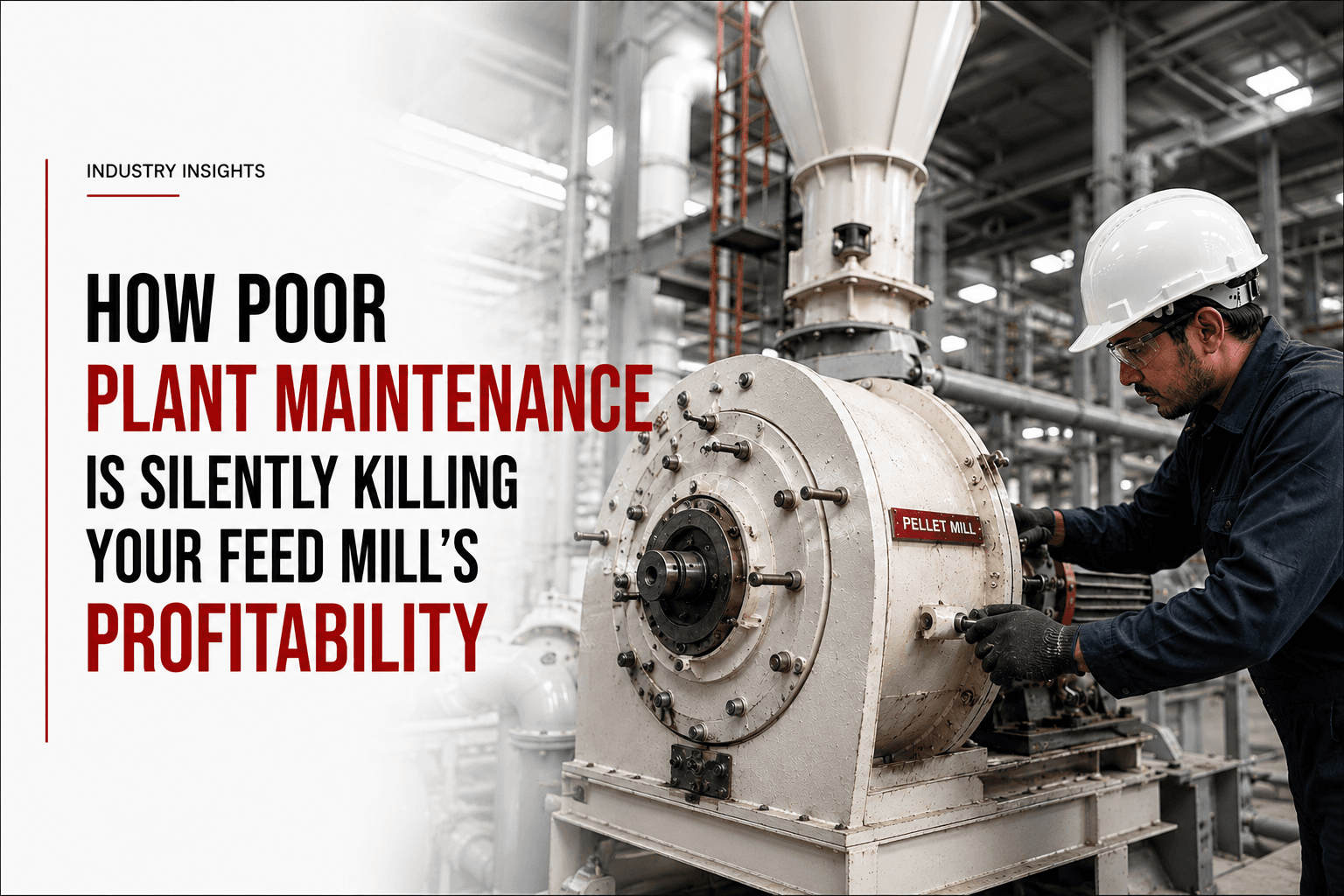
Maintenance7 August 20269 min read
How Poor Plant Maintenance Is Silently Killing Your Feed Mill's Profitability
T
Team Milling EquipsDiscover how neglected plant maintenance is quietly draining your feed mill's profits. Learn the real cost of deferred maintenance and how to fix it.
Ask any feed mill owner about their biggest challenges and you'll hear the same answers: raw material prices, energy costs, and competition. But there's a fourth profit killer that rarely gets mentioned — one that operates quietly in the background, slowly eroding margins, degrading quality, and shortening the lifespan of expensive machinery. That killer is deferred and neglected plant maintenance.
The irony is that most feed mill operators know maintenance matters. Yet day after day, maintenance tasks get pushed aside in favour of keeping the line running. The result? Small problems become big failures, and what could have been a ₹5,000 repair becomes a ₹5,00,000 breakdown.
In this blog, we expose the true financial cost of poor feed mill maintenance — and show you exactly how to stop the bleed. Whether you run a poultry feed plant, cattle feed mill, or aqua feed facility, these insights apply directly to your bottom line.
1. The Real Cost of Unplanned Downtime
When a critical machine fails without warning, the losses go far beyond the repair bill. A single unplanned breakdown in a mid-sized feed mill can trigger a cascade of costs that most operators never fully account for:
| Cost Category | Typical Impact |
|---|---|
| Lost production output | ₹50,000 – ₹2,00,000 per hour depending on plant capacity |
| Emergency spare parts (premium pricing) | 2x–4x the cost of planned procurement |
| Overtime labour for emergency repairs | 1.5x–2x normal labour rate |
| Raw material spoilage (conditioned but unprocessed) | Variable — can run into lakhs per incident |
| Customer order delays and penalties | Contractual penalties + long-term relationship damage |
| Quality rejections post-restart | First batches after emergency repair often fail QC |
According to the [Source: International Society of Automation (ISA)], unplanned downtime costs industrial manufacturers an estimated $50 billion annually worldwide. For Indian feed mills operating on thin margins, even a few hours of downtime per month can make the difference between profit and loss.
Real-World Example
A 10 TPH poultry feed plant running 20 hours/day loses approximately ₹80,000–₹1,20,000 in revenue for every hour of unplanned downtime. Two breakdowns a month = potential annual loss of ₹20–30 lakhs — enough to fund a full preventive maintenance programme several times over.
2. How Neglected Maintenance Degrades Feed Quality
Profitability isn't just about production volume — it's equally about product quality. Poor maintenance directly and measurably impacts the quality of feed you produce, which ultimately affects your customers' livestock performance and your reputation in the market.
- ✔ Worn pellet mill dies and rollers → lower Pellet Durability Index (PDI), increased fines, inconsistent pellet diameter
- ✔ Blunt hammer mill hammers → coarser, uneven particle size, poor ingredient digestibility in animals
- ✔ Damaged hammer mill screens → uncontrolled particle size distribution, failing quality specifications
- ✔ Faulty conditioner paddles → inadequate steam penetration, poor starch gelatinisation, weak pellets
- ✔ Misaligned mixer blades → non-homogeneous feed batches, nutrient variation between bags
- ✔ Cooler malfunctions → hot or high-moisture pellets, mould growth risk in bagged product
- ✔ Worn extruder screws → inconsistent extrusion pressure, poor pellet density and shape in aqua/pet feed production
- ✔ Damaged extruder sleeves/liners → barrel leakage and product contamination, leading to batch rejections
- ✔ Worn extruder die plates → irregular pellet size and increased fines, directly impacting product grading
- ✔ Blunt pulveriser machine beaters → coarser grind and higher energy consumption, reducing fineness consistency
- ✔ Worn pulveriser wear plate → metal-to-metal contact risk, causing machine damage and product contamination
- ✔ Damaged pulveriser teeth ring → uneven particle size distribution, failing quality specifications for fine-ground feed
Each of these quality failures carries real financial consequences: customer complaints, product returns, price negotiations, and ultimately, lost contracts. Your feed milling machinery is only capable of producing quality feed when it is properly maintained.
3. The Hidden Energy Drain of Poorly Maintained Equipment
Energy is the second-largest operating cost in most feed mills — and poorly maintained equipment consumes significantly more of it. This is one of the most overlooked consequences of deferred maintenance:
| Equipment Issue | Energy Impact |
|---|---|
| Worn pellet mill die (clogged holes) | Motor draws 15–25% more current to maintain throughput |
| Misaligned or worn V-belts | Power transmission loss of 5–15% |
| Dirty or blocked cooler | Increased fan motor load, longer cooling cycles |
| Choked hammer mill screens | Extended grinding time, higher kWh per tonne |
| Unlubricated bearings | Increased friction = direct energy waste + accelerated wear |
| Air leaks in pneumatic conveying | Compressor runs longer, electricity bill rises |
| Worn extruder screws & die plates | Motor overloads to maintain output pressure; energy per kg rises 20–30% as clearances widen |
| Poorly maintained dryer / cooler burners | Fuel consumption rises sharply; inconsistent moisture removal forces longer drying cycles |
| Worn pulveriser beaters & teeth ring | Grinding efficiency drops; machine runs longer per batch, increasing kWh per tonne significantly |
A feed mill consuming 40 kWh per tonne of feed produced could, with proper maintenance, reduce that to 32–35 kWh per tonne — a saving of 12–20% on your electricity bill simply by keeping equipment in optimal condition. At scale, this is a significant annual saving.
4. Accelerated Equipment Wear and Shortened Machinery Life
Feed mill machinery — pellet mills, hammer mills, extruders, mixers, conveyors — represents a capital investment of crores of rupees. Poor maintenance dramatically shortens the productive lifespan of this equipment, forcing premature capital expenditure that could have been avoided.
- ✔ A pellet mill die that should last 800 to 1000 hours may fail early if run with mismatched or worn rollers
- ✔ Bearings that should last 18–24 months fail in 6 months when under-lubricated or run hot
- ✔ Gearboxes that could run for 10+ years deteriorate rapidly when oil changes are skipped
- ✔ Extruder screws and liners wear 2–3x faster when run without correct temperature and pressure monitoring
- ✔ Conveyor belts crack prematurely when tension is not periodically adjusted
The solution is a structured preventive maintenance programmethat treats each machine's wear points systematically — before failure, not after. At Milling Equips, our maintenance services are designed specifically around the wear patterns of feed milling equipment to maximise machinery lifespan and ROI.
5. The Workforce Impact: Safety, Morale and Productivity
Poor plant maintenance doesn't just affect machines — it affects people. A poorly maintained feed mill is a more dangerous and demoralising place to work, with direct consequences for productivity:
- ✔ Unguarded or malfunctioning equipment increases accident and injury risk for operators
- ✔ Frequent breakdowns create unpredictable working conditions and erratic shift patterns
- ✔ Operators lose confidence in equipment reliability, leading to reduced productivity and higher staff turnover
- ✔ Emergency repairs often require untrained personnel to work under pressure, increasing error rates
Investing in operator training and plant maintenance creates a culture of ownership and accountability — where your team proactively spots and reports potential issues rather than waiting for machines to fail.
6. How to Shift from Reactive to Preventive Maintenance
The good news: transitioning from reactive to preventive maintenance does not require a massive budget or a complete operational overhaul. It starts with three simple steps:
Step 1: Audit Your Current Maintenance Gaps
- ✔ Walk your plant and list every machine
- ✔ For each one, ask: When was it last serviced? What are its high-wear components? Do we hold the right spare parts in stock? Is there a documented maintenance procedure?
Step 2: Build a Maintenance Calendar
- ✔ Assign maintenance tasks by frequency — daily, weekly, monthly, quarterly
- ✔ Tie tasks to production hours (e.g. every 500 hours of operation) where applicable
- ✔ Use a simple spreadsheet or a CMMS (Computerised Maintenance Management System) — explore our digital service tools
Step 3: Stock the Right Spare Parts
- ✔ Identify your top 10 highest-wear components and ensure 1–2 spares are always on hand
- ✔ Partner with a reliable spare parts supplier for fast replenishment — see our full spare parts range
Need help getting started? Contact the Milling Equips teamfor a free plant maintenance assessment — we'll identify your biggest risk areas and help you build a maintenance plan tailored to your equipment and production schedule.
7. The ROI of Preventive Maintenance: By the Numbers
Still not convinced that maintenance investment pays off? Here's what the data says:
| Maintenance Investment | Typical Return |
|---|---|
| Preventive maintenance programme | Reduces unplanned downtime by 30–40% |
| Regular die & roller replacement | Saves 15–20% on energy per tonne |
| Lubrication programme | Extends bearing life by 50–200% |
| Operator training | Reduces quality rejections by 10–20% |
| Strategic spare parts inventory | Cuts breakdown recovery time by 60–70% |
| Digital monitoring / SCADA | Reduces overall OpEx by 15–20% over 3 years |
According to [Source: Plant Engineering Magazine], every ₹1 spent on preventive maintenance saves ₹5–₹8 in reactive repair and lost production costs. For feed mill operators, this ratio makes preventive maintenance one of the highest-ROI investments available.
Conclusion
Poor plant maintenance is not a minor operational inconvenience — it is a systematic, compounding profit drain that affects energy costs, product quality, equipment lifespan, workforce safety, and customer relationships simultaneously. The longer it goes unaddressed, the more expensive it becomes to fix.
The feed mills that consistently outperform their competitors are not necessarily the ones with the newest equipment — they are the ones that maintain their equipment religiously. With the right maintenance strategy, spare parts support, and technical expertise from Milling Equips, your feed mill can operate at peak performance, year after year.
Frequently Asked Questions (FAQ)
How much does poor maintenance actually cost a feed mill per year?
This varies by plant size, but industry estimates suggest that reactive-only maintenance costs 3-5x more than a structured preventive maintenance programme when you factor in emergency repairs, lost production, quality rejections, and shortened equipment lifespan. For a 10 TPH plant, this can easily amount to ₹20-50 lakhs annually.
What is the most critical piece of equipment to maintain in a feed mill?
The pellet mill is typically the most critical — and most expensive to repair or replace. Its die, roller shells, main shaft, and gearbox all require regular inspection and timely replacement. However, hammer mills, mixers, and conveying systems must not be neglected as their failure can halt the entire production line.
How do I know if my feed mill has a maintenance problem?
Key warning signs include: frequent unplanned stoppages, rising energy consumption per tonne, increasing fines in finished product, customer quality complaints, and a growing backlog of 'pending' maintenance tasks. If any of these apply, a maintenance audit is overdue.
Can Milling Equips help us set up a preventive maintenance programme?
Yes. Milling Equips offers maintenance consultancy, spare parts supply, operator training, and digital monitoring solutions to help feed mills transition from reactive to preventive maintenance. Contact us to schedule a free plant assessment.
What digital tools are available to help manage feed mill maintenance?
Modern feed mills are increasingly using SCADA systems, IoT-based condition monitoring, and CMMS software to track maintenance schedules, monitor equipment health in real time, and receive early-warning alerts before failures occur. Milling Equips can advise on the right digital tools for your plant size and budget.
Ready to upgrade your milling setup?
Discuss your plant requirements with our engineering team today.